How Autonomous Vehicles Handle Real-World Chaos: PG&E Outage Lessons
William Harrison ·
Listen to this article~4 min
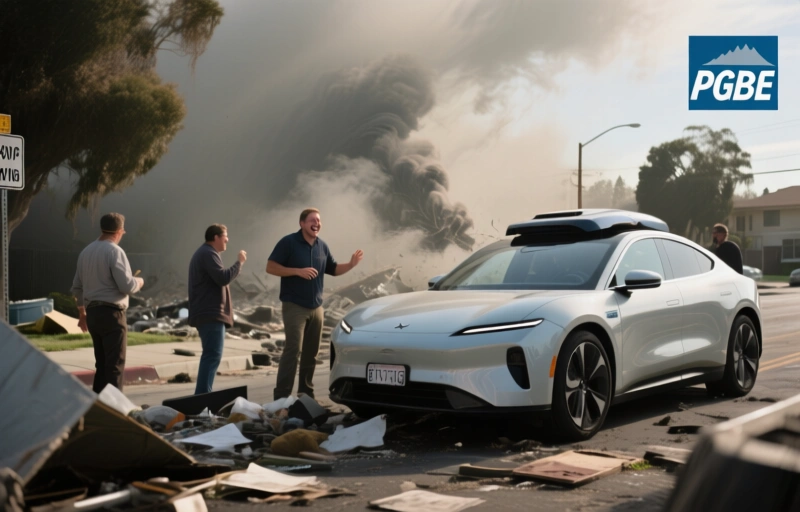
When a PG&E blackout killed traffic lights, it became a real-world test for autonomous vehicles. Discover how they navigated the chaos and what it reveals about the next phase of AI maturity in our fragile infrastructure.
Let's talk about what happens when the predictable world we've built for autonomous vehicles suddenly isn't so predictable anymore. You know those carefully mapped streets, those traffic lights that always work, those clear lane markings? Sometimes, they just vanish. That's exactly what happened during a recent PG&E power outage, and it taught us something fascinating about how self-driving technology is growing up.
It's easy to think of autonomous vehicles as just following a digital map. But the real test isn't navigating a perfect grid. It's navigating the messy, unpredictable reality of human infrastructure when it fails. When the power goes out, traffic signals go dark. Streetlights disappear. Digital signs go blank. For a human driver, that's stressful. For an AI, it's a completely different set of rules.
### The Blackout Scenario: A Driverless Car's Nightmare
Imagine you're a Waymo vehicle cruising through San Francisco. Your sensors are painting a picture of the world, your software is making decisions in milliseconds. Then, the grid goes down. Suddenly, intersections become four-way stops with no human to wave you through. Your usual reference points are gone. This isn't a simulation anymore; this is the real, unscripted world throwing a curveball.
The outage forced these vehicles to fall back on their most fundamental skills: perception and prediction. Without working traffic lights, they had to rely entirely on detecting other vehicles, reading body language of pedestrians, and understanding the implicit rules of a dead intersection. It's like having a conversation where all the words are removed, and you have to understand everything through gestures and context.
### What This Teaches Us About AI Maturity
This event wasn't a failure. It was a critical lesson. It showed that the next phase of autonomy isn't about handling more miles on sunny days. It's about building robustness for the exceptions. Here's what the industry learned:
- **Redundancy is everything.** Systems can't rely on a single data source. When GPS or cellular data gets spotty, the car's own cameras, lidar, and inertial sensors have to take over.
- **Context is king.** An AI needs to understand that a dark traffic light means 'treat as a stop sign,' not 'ignore this object.' It needs social awareness of how humans behave in these situations.
- **Graceful degradation is the goal.** The vehicle can't just freeze. It has to safely slow down, communicate its intentions, and find a secure place to stop if necessary, all while prioritizing safety above all else.
As one engineer put it, 'We're not just teaching cars to drive. We're teaching them to cope.'
### The Bigger Picture for a Digital Society
This goes far beyond cars. It's a blueprint for any autonomous system operating in our physical world—delivery robots, drones, smart city infrastructure. Our society is becoming more automated, but our infrastructure is fragile. Power fails. Networks drop. Weather interferes. The true measure of this technology won't be its performance on a good day, but its resilience on a bad one.
The PG&E outage was a real-world exam, and it proved something vital. It showed that this technology is moving from controlled testing into adaptive learning. The cars didn't just survive the blackout; they navigated it by reading the room, so to speak. They observed human drivers cautiously proceeding and did the same. That's a huge leap from rigid programming to situational understanding.
So, what's the takeaway for professionals watching this space? The frontier is no longer about the core driving task. It's about building AI that doesn't just follow the map, but understands when the map is wrong. It's about creating systems that are partners in our unpredictable world, not just passengers on a pre-planned route. The next breakthroughs won't be about adding more features, but about deepening the understanding of when—and how—to use the ones they already have.