Writing With Your Eyes: How Eye Gaze Tech Gives Voice
William Harrison ·
Listen to this article~4 min
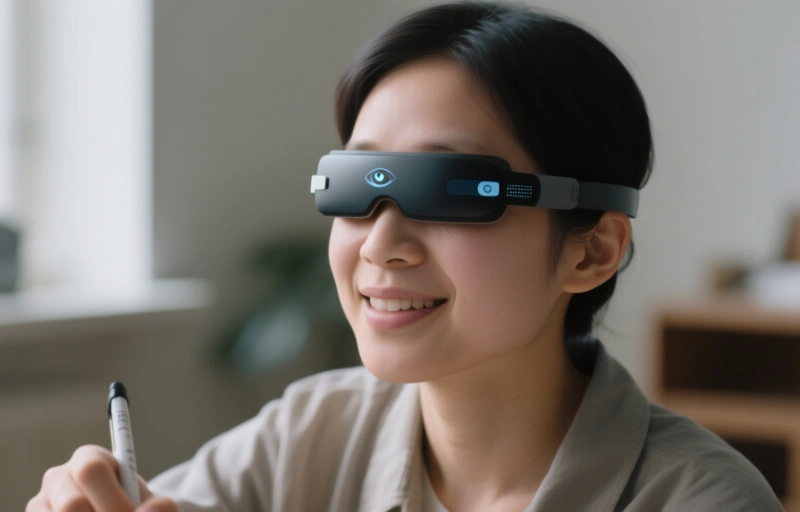
Guest blogger Jessie Towbin wrote an entire post using only eye gaze technology, showcasing how assistive tech provides a vital voice for those with conditions like ALS and redefining digital inclusion.
Imagine writing an entire blog post without ever lifting a finger. Without typing a single key. That's exactly what guest blogger Jessie Towbin did, using only the movement of her eyes. It's a powerful story about technology, resilience, and the human need to connect.
This isn't science fiction. It's a real technology called eye gaze tracking, and for people living with conditions like ALS, it's not just a tool—it's a lifeline to the world. It transforms a simple computer screen into a canvas for communication, controlled entirely by where you look.
### How Eye Gaze Technology Actually Works
So, how does someone write with just their eyes? The system uses a specialized camera mounted below a screen. This camera tracks the precise point where your pupils are focused. Think of it like a mouse cursor, but one you control with incredible subtlety and intention.
You look at an on-screen keyboard, dwelling on a letter for a moment to select it. You can build words, sentences, and entire paragraphs. It requires patience and practice, but it gives back something priceless: a voice.
- It allows for written communication, like emails and blogs.
- It enables control of smart home devices.
- It can operate entertainment systems for independence.
- It provides a critical channel for personal expression.
### More Than Just a Tool
When we talk about assistive technology, it's easy to get lost in the specs. But the real story is about what it enables. For someone like Jessie, this technology isn't about convenience. It's about agency. It's about continuing to share ideas, tell stories, and maintain relationships on her own terms.
That's a profound shift. It moves the conversation from limitation to possibility. The technology itself is clever, but the human determination behind it is what's truly inspiring. It reminds us that the drive to create and connect is a fundamental force.
As one advocate put it, "When speech is taken, technology can return the right to be heard."
### The Broader Impact on Digital Inclusion
Jessie's story highlights a crucial point in our digital society: true innovation must be inclusive. As we rush toward a future shaped by AI and automation, we have to ask who gets left behind. Eye gaze technology is a brilliant example of building bridges instead of walls.
It challenges developers and designers to think differently about user interfaces. If you can build a system that works for someone with extremely limited mobility, you often create a better, more intuitive system for everyone. That's the beauty of universal design principles.
### Looking Forward
Stories like this one force us to reconsider what's possible. They blur the line between human and machine in the most humane way possible—by amplifying our inherent humanity. The next frontier isn't just about making technology smarter; it's about making it more empathetic and accessible.
Jessie's blog, written letter by letter with the quiet focus of her gaze, stands as a powerful testament. It proves that the need to express ourselves is unstoppable. And with the right tools, no barrier is absolute. The future of work and communication must make room for every kind of voice, especially those that speak through silence.