Micron and Palantir: AI's Hardware and Software Powerhouses
William Harrison ·
Listen to this article~4 min
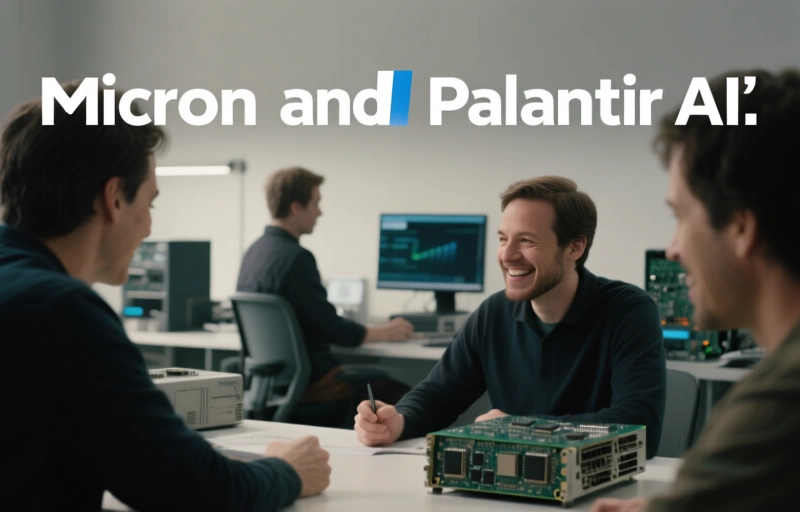
Micron Technology and Palantir Technologies represent the essential hardware and software pillars of the AI era. One builds the advanced memory chips powering models, the other creates the platforms to operationalize data. Their convergence tells the story of modern tech infrastructure.
Let's talk about two companies that keep popping up in conversations about where technology is headed. I'm not talking about the usual social media giants. I'm talking about the backbone players—the ones building the physical and digital infrastructure for our AI-driven future. On one hand, you've got Micron Technology. On the other, Palantir Technologies. They operate in very different lanes, but together, they tell a compelling story about the current tech landscape.
### The Memory Behind the Machine
Think about Micron for a second. What do they do? They make memory and storage chips. Sounds simple, maybe even a bit boring compared to flashy AI software. But here's the thing: you can't run complex AI models without powerful, efficient memory. Every large language model, every data-intensive application, is utterly dependent on the kind of high-bandwidth memory (HBM) and DRAM that Micron specializes in. It's the unsung hero. The hardware that makes the software magic possible. As AI workloads get bigger and more demanding, the need for advanced memory solutions isn't just growing—it's exploding. Micron sits right at the center of that demand curve.
### The Brain Making Sense of the Data
Now, shift gears to Palantir. If Micron provides the foundational hardware, Palantir builds the sophisticated software layer on top. Their platforms, like Foundry and Gotham, are designed for one primary purpose: helping massive organizations—governments and large enterprises—make sense of colossal, messy datasets. In an era where data is the new oil, Palantir provides the refinery and the distribution network. They don't just store data; they connect it, analyze it, and turn it into actionable intelligence. Their recent push into commercial AI platforms, especially for defense and enterprise clients, shows they're betting big on the operationalization of AI.
What's fascinating is how these two roles are converging. Palantir's AI software needs the cutting-edge hardware Micron produces to run effectively at scale. Conversely, the data processed by Palantir's systems often ends up informing the next generation of hardware needs. It's a symbiotic relationship, even if they're not direct partners. One fuels the other's capabilities.
- **Micron's Play:** Capitalizing on the AI hardware boom. More AI servers mean more demand for their memory chips.
- **Palantir's Play:** Embedding itself as the central nervous system for large institutions, using AI to drive decision-making.
- **The Common Thread:** Both are essential, albeit different, components of the same technological evolution.
As one industry observer recently noted, 'The real transformation isn't in the algorithms alone; it's in the entire stack, from the silicon to the dashboard.' That's the space these companies occupy. They're not just participating in trends; they're enabling them. For professionals watching the sector, understanding this hardware-software dynamic is key. It's not about picking one over the other. It's about recognizing that a mature tech ecosystem needs robust players at every level. The performance of companies like Micron and Palantir often serves as a leading indicator for the health and direction of broader tech adoption, especially in enterprise and government sectors that move slower but spend bigger. Their stories are worth following closely, not as isolated stocks, but as chapters in the larger narrative of how our digital world is being built, piece by critical piece.